

Francis Halzen Awarded 2026 Nobel Prize in Physics
October 6, 2026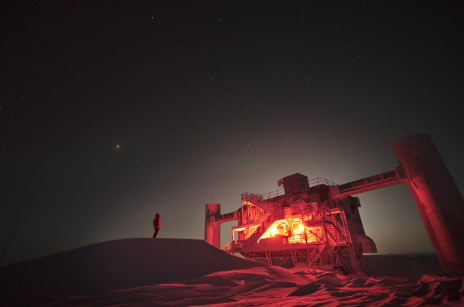
Congratulations to Francis Halzen who was awarded the 2026 Nobel Prize in Physics for contributions to the IceCube Neutrino Observatory in Antarctica and the discovery of high-energy neutrinos. Halzen, a UW—Madison physicist, and the IceCube researchers have long collaborated with the Center for High Throughput Computing (CHTC), who provides computing resources, allowing IceCube to analyze the massive amounts of data it collects. “We have used CHTC and the Open Science Pool (OSPool) for over a decade to perform all large-scale data analysis tasks and generate Monte Carlo simulations,” Halzen has noted. The Open Capacity offered by UW—Madison via CHTC supported their work going back to the AMANDA Project, IceCube’s predecessor.
CHTC’s HTCondor Software Suite (HTCSS) stands as a signature example of translational Computer Science, creating distributed computing and workflow technologies that are deployed as real, usable computing capacity enabling Nobel‑quality discovery—most recently demonstrated by IceCube, the fourth Nobel winner to rely on HTCSS.
Another major contributor to this effort is the National Science Foundation’s sustained support of CHTC and its capability to provide open computing capacity to IceCube. In the past year alone, IceCube’s research ran over 53 million jobs using CHTC and OSPool resources, utilizing over 79 million CPU hours, over 2 million GPU hours, and transferring over 11 million GB of data. Halzen acknowledged CHTC’s contributions:
“Without CHTC and OSPool resources, we would simply be unable to make any of IceCube’s groundbreaking discoveries.”
Read more about IceCube’s collaboration with CHTC
From the CHTC archives
IceCube Neutrino Observatory’s Use of High Throughput Computing: Making Discoveries in Astrophysics Using Neutrinos

IceCube captures 233 million cosmic rays every day, opening the door to groundbreaking discoveries in high-energy physics.

Located in the depths of the South Pole almost a mile under the earth’s surface, the IceCube Neutrino Observatory spans one cubic kilometer of ice—roughly the equivalent of one million swimming pools. The Observatory searches for subatomic particles called neutrinos, an elementary particle created by various forms of radioactive decay, and studies some of the most cataclysmic events in the universe—such as exploding stars. The first gigaton neutrino detector ever built, IceCube was primarily designed to observe neutrinos from the most violent astrophysical sources in our universe, allowing scientists to unlock new insights into astrophysics, cosmic rays, dark matter, and more. To do so, the IceCube Observatory captures 233 million cosmic rays every day, opening the door to groundbreaking discoveries in high-energy physics. The immense scale of the work IceCube does is made possible through its collaboration with the Center for High Throughput Computing (CHTC) who provides computing resources, allowing IceCube to analyze the massive amounts of data it collects.
Notoriously difficult to observe due to their physical properties, the study of neutrinos from astrophysical phenomena is the primary focus of IceCube. Taking the innovative approach to study these particles, IceCube detects and studies the particles via light detectors buried in Antarctic ice. The optical clarity of the ice, when interacting with the neutrinos, produces electrically charged particles that can be then captured by IceCube sensors. By detecting neutrinos in this indirect manner, IceCube has the heavy computational workload of converting messages into light patterns that disclose the energy and direction of neutrinos.